Old ways, checked twice
MeeraA household handbook

The grandmother rules that kept Indian kitchens from throwing money away.

Stop paying twice for spices that go stale, pans that never needed replacing, and creams that promise more than a jar of oil ever did — using the sixty household methods Indian homes have run for generations, written out plainly for an American kitchen. Re-season one iron pan instead of buying a new one and the Handbook has paid for itself.

60

Household methods

240K+

Views on one coconut oil video

7-Day

Refund guarantee

Meera, presenter of The Indian Way
Not for becoming Indian. For wasting less of what you already bought.
Meera · The Indian Way
I.

The Handbook

One book. Sixty methods. A kitchen that stops leaking money.

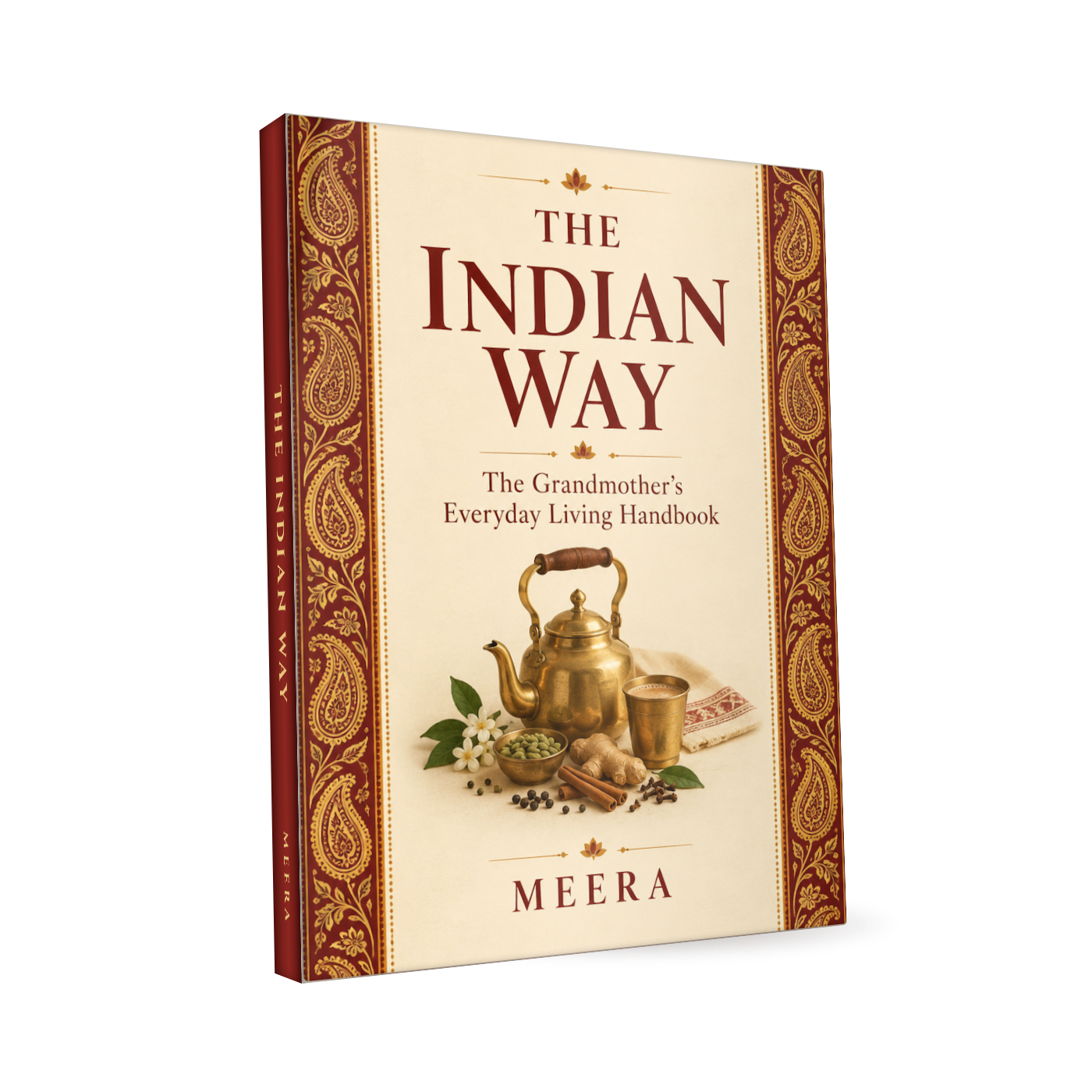
Spices, chai, pantry, cookware, skin, hair, and the small daily routines. Six sections. Sixty methods. Each one with the materials, the American-store equivalent, and the step-by-step. Start this weekend with one steel spice tin and a twenty-minute pantry sort.

The Indian Way book cover

Illustrated ebook · 276 pages · First Edition

The complete household guide to wasting less the Indian way.

A masala dabba that ends duplicate spice buying. Chai brewed in the right order. A re-seasoned iron kadai. Lentils stored so they last. Coconut oil used the way it was meant to be. A steel tiffin instead of another plastic tub. Sixty methods Indian households have relied on for generations — with exact quantities, U.S. store equivalents, and honest notes on what each one does and does not do.

$39One time · No subscription

What you get for $39:

  • The Indian Way Handbook — 276-page large-print PDF, sixty numbered methods, materials lists, step-by-step
  • One-page House Cards to tape inside your cupboards
  • Taped kitchen notes and Hindi household sayings, with pronunciation
  • Glossary, full source list and an index by problem
  • Lifetime updates — every revision and new edition, free
  • You pay today$39
Get the Handbook · $39 →

Instant access · Pay once · Yours forever

II.

The Math

Nearly $8,000 a year. That is what the average American household spends on the three costs this book goes after.

These are not our numbers. They come from the U.S. government. The left column is what the average household pays every year. The right column is where the methods in the Handbook do their work.

The average American household

Per year
  • Food bought, then thrown away (household of four)$2,913
  • Eating and drinking out — the coffee-shop chai, the takeout$3,945
  • Personal care — creams, oils, shampoos, salon$978
Annual$7,836

Sources: U.S. EPA (2025) wasted food cost · U.S. BLS Consumer Expenditure Survey (2024)

Where the Handbook helps

  • Food waste: pantry rotation, steel storage, right-size cooking
  • Eating out: chai and drinks made at home
  • Personal care: one good oil used properly instead of a shelf of jars

Savings depend on your household. We don't promise a number.

III.

What's inside

Exactly what you get for $39.

Sixty numbered methods across six sections. Each one: a short explanation, a walked-through how-to, the materials with their U.S. store equivalents, and an honest note on what it does and doesn't do. Pick the methods that fit your kitchen — you do not have to do all of them.

Spices — 12 methods

Buying less and tasting more.

  1. 01The masala dabba rule that ends duplicate buying
  2. 02Whole vs ground: which to keep, which to skip
  3. 03Dry-roasting to wake up tired spices
  4. 04Storing cardamom, cloves and saffron so they last
  5. 05The small-bag rule for American supermarkets

Chai & drinks — 10 methods

The cup that costs cents, not dollars.

  1. 01The order that makes chai taste right
  2. 02Ginger, cardamom, clove — how much and when
  3. 03Milk, water and the boil-over fix
  4. 04Jeera water and fennel water, plainly explained
  5. 05Making a week of chai masala in ten minutes

Pantry — 11 methods

Keeping food until the day you eat it.

  1. 01Steel-tin dal storage that keeps bugs out
  2. 02The first-in, first-out shelf
  3. 03Bay leaves, neem and the old pantry guards
  4. 04Right-size shopping for a household of one or two
  5. 05Rice and flour: what keeps, what doesn't

Cookware — 10 methods

Repair before replace. Pans that outlast you.

  1. 01Rescuing a rusty iron kadai
  2. 02Seasoning a tawa the traditional way
  3. 03Steel pots: the scrub that brings them back
  4. 04Copper and brass: what is safe for food, what is not
  5. 05Clay pots and the questions to ask before you buy

Skin & hair — 9 methods

One bottle of oil instead of a shelf of jars.

  1. 01Coconut oil before washing — the right amount
  2. 02The evening foot-oil routine, done safely
  3. 03Amla, hibiscus and methi: what they can and can't do
  4. 04Patch-testing before you try anything new
  5. 05Reading a hair-oil label before you buy

Daily routines — 8 methods

The small habits that run a calm household.

  1. 01The Indian evening routine, four parts worth keeping
  2. 02Oil massage (abhyanga) after 60: setup and precautions
  3. 03Steel tiffins and cloth: the zero-waste lunch
  4. 04The weekly kitchen reset
  5. 05Thirty old household habits worth keeping

Showing a selection from each section. All sixty methods are in the Handbook.

IV.

Your first week

What the first seven days with the Handbook look like.

Three small jobs. Three different rooms of the house. Each one saves money you were already spending.

Day 1 · The spice shelf

Empty every spice jar onto the counter. Toss what has no smell. Fill one steel masala dabba with the seven you actually use. Write the refill chart. You will not buy a duplicate jar of cumin again.

Day 3 · The iron pan

Take the iron pan you were about to throw out. Scrub, dry on the flame, oil, heat, repeat. Forty minutes and a spoon of oil. The pan goes back on the stove instead of into the trash.

Day 7 · The chai pot

Brew one pot of chai in the right order — water, spices, tea, then milk. Compare it to the bottle in your fridge. Then work out what a year of the bottled kind costs.

Meera, presenter of The Indian Way
V.About the presenter

Meera.

Indian kitchens ran for generations on a short list of rules. Buy whole spices, in small amounts. Keep them in steel. Repair the pan before you replace it. Use one good oil for a dozen jobs. Nobody called it saving money. It was just how a household was run.

The Indian Way takes those rules out of the kitchens they came from and writes them down for an American home — spices, chai, pantry, cookware, skin, hair, and the small daily routines that add up over a year. Every method is checked against modern safety guidance before it goes in, and every one comes with a plain note on what it can and cannot do.

This First Edition is the channel's methods, organized. Sixty of them, across six sections, in the order worth doing them, with the quantities and the U.S. store equivalents written down. Read it once, pick the methods that fit your house, and keep the savings.

This is not a book about becoming Indian. It is a book about wasting less of what you already have.
Watch the channel
VI.

Order the Handbook

$39 once. No subscription. Yours to keep.

Instant access — in your inbox within a minute of paying. Read it on your phone, tablet, or computer. Print the charts and tape them inside the pantry door. 7-day money-back guarantee, no questions asked — if it isn't for you, reply to your Gumroad receipt email and the $39 comes back.

The Indian Way book cover

Illustrated ebook · 276 pages · First Edition

The complete household guide to wasting less the Indian way.

A masala dabba that ends duplicate spice buying. Chai brewed in the right order. A re-seasoned iron kadai. Lentils stored so they last. Coconut oil used the way it was meant to be. A steel tiffin instead of another plastic tub. Sixty methods Indian households have relied on for generations — with exact quantities, U.S. store equivalents, and honest notes on what each one does and does not do.

$39One time · No subscription

What you get for $39:

  • The Indian Way Handbook — 276-page large-print PDF, sixty numbered methods, materials lists, step-by-step
  • One-page House Cards to tape inside your cupboards
  • Taped kitchen notes and Hindi household sayings, with pronunciation
  • Glossary, full source list and an index by problem
  • Lifetime updates — every revision and new edition, free
  • You pay today$39
Get the Handbook · $39 →

Secure checkout · Pay once · Yours forever

Secure checkout · Visa · Mastercard · PayPal · Apple Pay · 7-day refund

VII.

FAQ

Questions readers ask before they buy.

Yes. Every method is written for an ordinary U.S. home and a regular supermarket. Where an Indian ingredient or tool is mentioned, the Handbook gives the American-store equivalent and what to use if you can't find it. Nothing requires a trip to a specialty shop unless you want one.

Yes. Most of the Handbook is about storing, caring for and getting more out of things you already own — spices, pans, oils, leftovers. You don't need to cook a single curry to use the pantry, cookware or routine sections.

The spice shelf and the iron pan take one afternoon each. How much you save depends on your household; the Handbook doesn't promise a number.

Every method that touches food, skin or hair comes with a plain safety note — when to patch-test, who should skip it, and when to ask your doctor or pharmacist first. Nothing in the Handbook replaces medical advice.

An illustrated PDF ebook, readable on any phone, tablet or computer, with printable charts. You get the download link by email the moment you pay.

Possibly. Buyers get every update to this edition free.

7-day money-back guarantee. Reply to your Gumroad receipt email within 7 days and the full $39 comes back. No form, no questions.

Check your spam or promotions folder, or reply to your Gumroad receipt.

Last call

Stop paying for food you throw away.

The average household of four throws away $2,913 of food a year (U.S. EPA). $39 once. Instant access. 7-day money-back guarantee. Sixty methods, six sections, 276 pages, lifetime updates.

Get the Handbook · $39 →